
Ethlabs Week 9: What happened when we all got into one room
If you told me a few weeks ago that I would be sitting in Lower Manhattan, on one of the sunniest days of the year, voluntarily ignoring the outside world because I was excited to write a weekly update, I… would have believed you.
Apparently, this is who I am now. But honestly, I think this is who I have always been; I was just missing an Ethlabs in my life that lets it out.
I have always had a soft spot for companies that let you see how things actually happen, because in an age when tech companies pay millions of dollars for blockbuster-level marketing posts, it’s quite rare to see raw retellings of events before they get flattened into an announcement. At Ethlabs, we do these weekly updates for exactly that reason: to share personal accounts about what the organization is up to, hopefully boosting awareness of our work and letting readers reach out if they would like to help.
And after our first Ethlabs offsite, there is a lot to show you.
And yes, I get it: guy joins new team and immediately says the team is special.
Grotesque behavior. But this one is special, I promise.
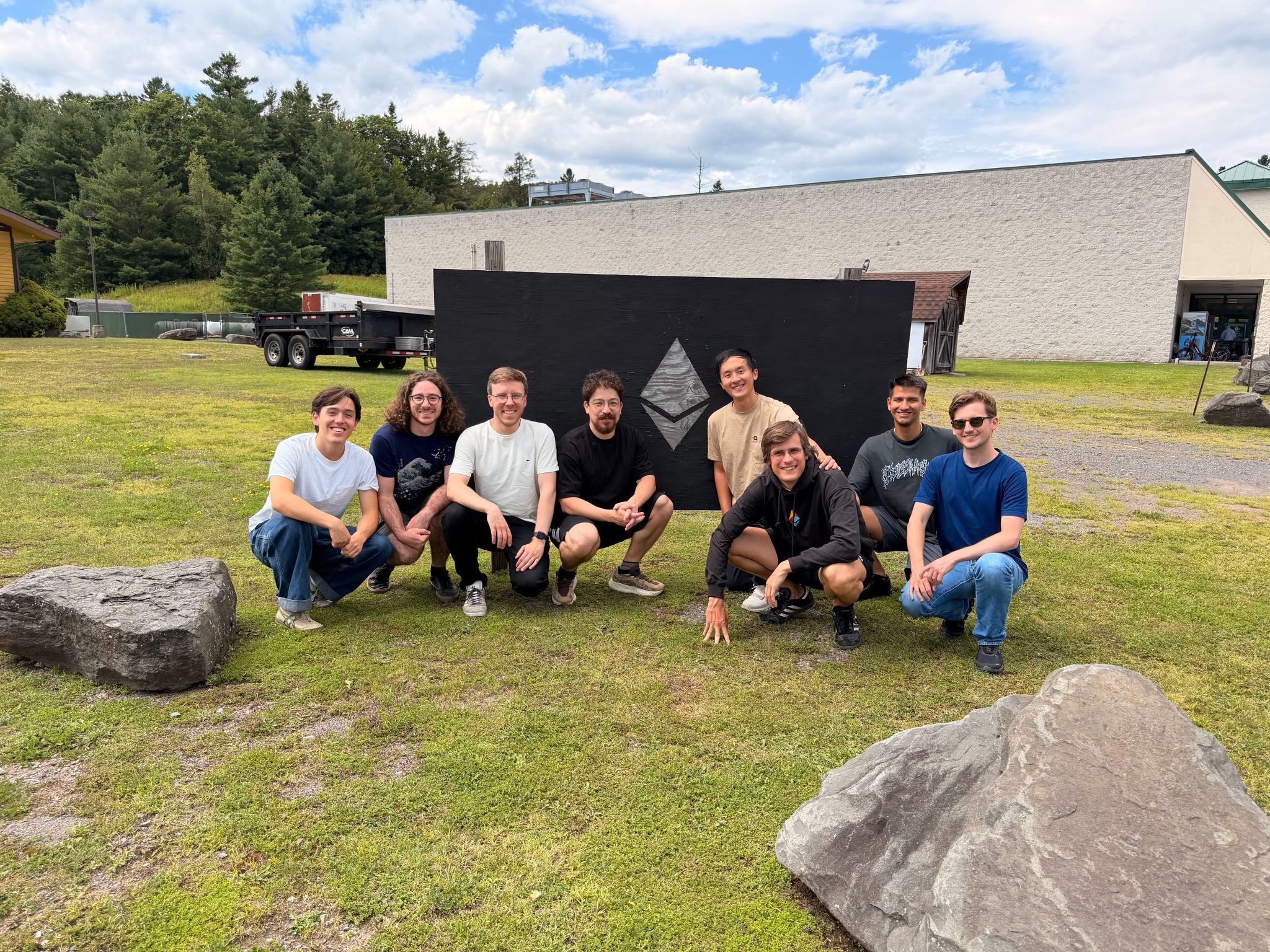
#For those of you less familiar with Ethlabs
We are a 9-week-old non-profit R&D lab for Ethereum and ETH, and our mission is to make Ethereum the settlement layer of the global economy. We believe that Ethereum gets better when the people building all its layers from the protocol, the products on top of it, and the markets using it can actually work on problems together. We listen obsessively to users, wallets, apps, rollups, institutions, $ETH holders, researchers, and client teams to understand what the network is getting right and where it is getting in their way. Sometimes we even experiment onchain because we believe that you cannot build an arena without participating in it, and we are not afraid to make opinionated bets from first principles about what we think Ethereum should become.
Now the rest of this article will go on to tell you more about our team, but I have to start with something even more important: cosmic signs. I am not one for superstitions, but some things occurred during our first offsite that would make even the biggest skeptic question themselves.
#The Sign
We hosted our offsite in Hunter, NY, a place @casparschwa selected. To be honest, none of us really questioned it; if you have ever met the man, you will know he has taste.
In the truest spirit of Ethereum, we have formed a deeply globally distributed team, and so we had everyone fly in from various corners of the world. Francesco and Barnabé, who flew in from Europe, arrived first, and they were greeted by something that might be the strangest thing any of us have experienced in a long, long time.
Imagine this
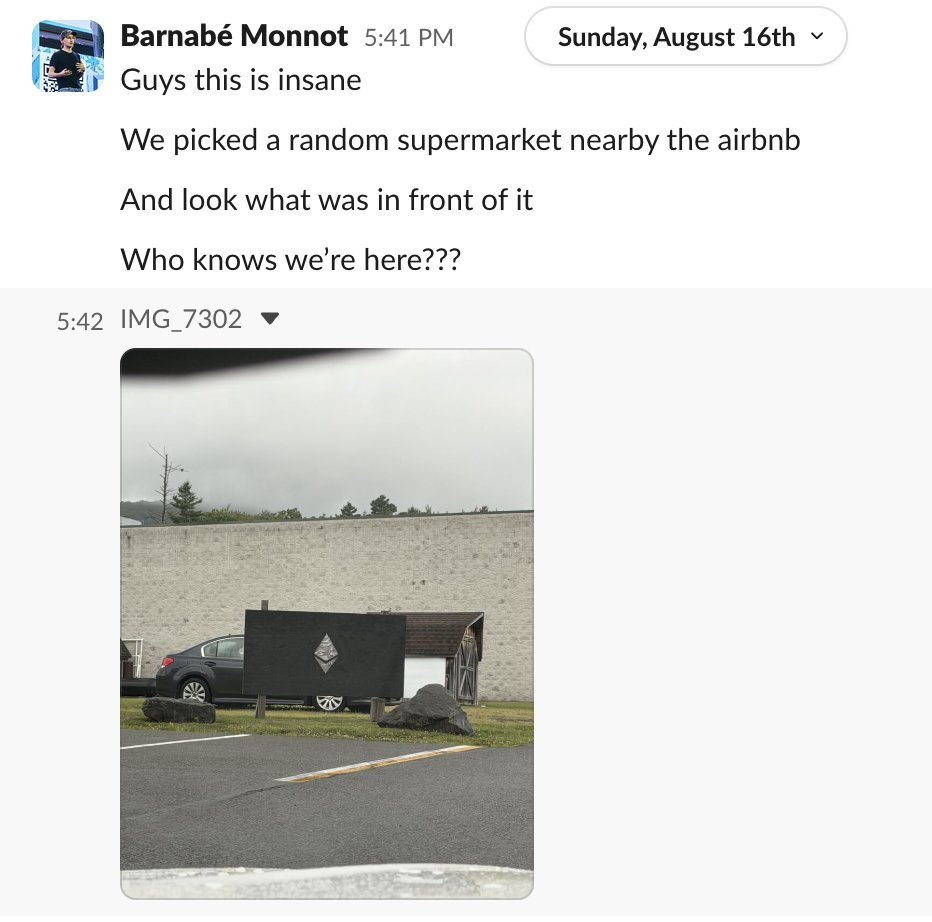
A beautifully carved-out, proportionate Ethereum logo in the middle of a random supermarket in Hunter, NY, with no explanation, nothing, right by the place that Ethlabs hosted its first offsite. It was, quite literally, and figuratively; a sign.
#Okay, so what did we actually do?
The slightly less mystical answer is: a lot.
This was the first time almost everyone at Ethlabs had been in the same room, and what became very obvious in person was just how broad the team’s skill sets are. Our team is spread across countries, time zones, disciplines, and very different histories with Ethereum; you can get a great glimpse of our various personalities from @decentrek’s post here:
I'm on my way back from Ethlabs's first 5-day offsite, which was also the first time I met my colleagues in person. Wanted to share some impressions of my colleagues, in no particular order:
— Derek Chiang | Ethlabs (@decentrek) August 21, 2026
- @fradamt being the most research-y among us, i honestly sort of expected him to be a…
A discussion at Ethlabs can start with us testing an app during lunch and noticing how long it takes to bridge, and eventually move through us chatting about wallet behavior and bridge liquidity, then descend into confirmation rules and protocol constraints, and finally end with a much more important question: where does this problem actually belong? Is it something the protocol should solve, something better handled by a wallet or application, or simply a coordination problem nobody has taken ownership of yet? And if the discussion started over lunch: is the food here yet?
Our first offsite was useful because many of the threads we’ve written about over the last eight weeks finally got to exist in the same room. It’s still early days at Ethlabs, and we have more coming in quickly, but being together has let us bucket our early (and ever-growing!) work and philosophies into core pieces and theses. Here are a couple of them:
#1. Faster Ethereum
If you’ve followed the last few updates, this one should look familiar. We have increasingly come to believe that a faster Ethereum is a better Ethereum, and better for ETH. For us today, that means faster blocks, faster confirmations, faster finality, and faster interop.
Over the last few weeks, Barnabé has been pushing EIP-8198: Quick Slots for consideration in Hegotá, with the immediate proposal making slot time configurable and incrementally reducing it from its current 12 seconds. We will continue to advocate for its inclusion as Hegotá scoping progresses, as we believe it is essential to integrate it during that upgrade.
Today I will be proposing faster slots for inclusion in Hegotá, to All Core Devs.
— Barnabé Monnot | barnabé.eth (@barnabemonnot) August 6, 2026
Faster slots improve the value of Ethereum blockspace. This is value that accrues to Ethereum users, to the network as a whole, and to ETH in particular.
While we cannot expect more than a… pic.twitter.com/Wc0WxMcZY9
In addition to our work on quick slots, the Fast Confirmation Rule (FCR) has continued to move from research toward deployment. Last week, Derek and Julian shared that a major bridge is preparing to adopt FCR in production. This week, we made further progress on the work required around that rollout and broader adoption. FCR allows systems to obtain a strong confirmation signal much earlier than full Ethereum finality. In practical terms, that can make deposits originating on Ethereum roughly 32x faster in the best cases.
— Derek Chiang | Ethlabs (@decentrek) August 15, 2026
The important thing now is getting this 32x improvement into the hands of real end users. That means working with bridges, exchanges, L2s, and applications on the engineering, validation, and adoption work required to turn a protocol improvement into something end-users can actually experience.
For us, research is not finished when the paper is written, but when somebody feels the improvement.
#2. Interop
The north star should be that: moving anything between any two chains “should just work in 1 second, seamlessly” without giving up Ethereum as the source of truth. Near-term, that’s mostly going to look like protocol and standardization work: in the short term, wallet teams have told us that they maintain seven different adapters for seven token-bridging standards; this mess is fixable, and we will continue to explore pragmatic ways to do just that.
A core theme from the offsite was that we must become better at distinguishing between problems that require fundamental protocol or platform changes and those where the ecosystem simply needs someone to coordinate. You do not always need to engineer an entire solution when just an introduction would do. We saw this firsthand when we identified a problem during a meeting with a DeFi team and then met with an L2 team trying to fix that same problem; we have since connected them.
It's ironic that Base bridges faster to Solana than to Ethereum
— Derek Chiang | Ethlabs (@decentrek) August 19, 2026
Right now, the Base -> Ethereum bridge operates in a "multi-prover" model, where if a TEE and a ZK prover agree on Base's state transitions, then a Base state update can settle on Ethereum in 1 day. Why 1 day?…
#3. ETH
Our mission is to grow Ethereum as the platform and ETH as the asset, but historically, the protocol development side of Ethereum has been much more comfortable talking about the first half of that sentence than the second, and this has created a vacuum. We believe that Ethlabs can contribute something useful here, but the answer is not empty promotion. You should expect to hear more from us about ETH, both as individuals and as an organization.
#4. Becoming a coordination layer
Connecting protocol to product to apps to users. The impromptu gallery event we hosted while in NYC was a brief teaser of how we see ourselves as helpful as a coordinator: within 24 hours, we brought researchers, DeFi founders, institutional leaders, NFT curators, DAT operators, and consumer app devs into one room in Bowery. Not only did we see the appetite for more Ethereum meetups and the resiliency of New Yorkers who show up no matter what (even during a thunderstorm!), but we also saw firsthand the magic that can happen when two unlikely people have a conversation that unlocks a spark in their eyes or an idea in their heads. We believe Ethereum is strongest when it is together, and we will try to bring the ecosystem together whenever possible.
we hosted an impromptu @ethlabs_org event at a gallery in nyc
— binji (@binji_x) August 21, 2026
ty @TimeToBeHappyGY 🫡 pic.twitter.com/uAoxHv5lzM
#5. Demand to delivery
A big risk for protocol organizations is solving elegant problems nobody is actually asking to have solved. One way to prevent this is through transparency so everyone can follow what we are doing i.e these weekly update articles, and another way is to consistently run concentrated discovery sweeps across wallets, apps, DeFi, L2s, institutions, and other builders while utilizing a simple leading question: what don’t you like about Ethereum? From there, our job is to trace the problem down the stack, figure out the right layer to solve it at, and either solve it ourselves or help the right people do it. Barnabé borrowed a useful phrase for part of this: GROSS, Get Rid of Stupid Stuff. If something about Ethereum annoys you, our DMs are open.
Our other discussions were lengthy; we held multiple sessions across core ideas and struggles within the Ethereum ecosystem, and look forward to sharing more in the weeks to come.
A quick teaser of one such subject:
at @ethlabs_org, we believe in strengthening the L1 & L2 relationship pic.twitter.com/6n5oOxkKR3
— binji (@binji_x) August 21, 2026
#What changed after the offsite?
The Faster Ethereum work continues, with Quick Slots moving deeper into the Hegotá discussion and FCR moving closer to real deployment. Interop now has a clearer north star and a distinction between protocol problems and coordination problems. ETH continues to be an explicit part of our public work, and demand-to-delivery + building for today’s outcomes will continue to be a deliberate mechanism for deciding what we work on.
There is still a lot we do not know, and that is partly the point of publishing these updates: you should be able to watch our thinking develop every week, criticize us when helpful, and work openly with us to grow both the network and the asset that we all love.
#Onwards to Week 10
We are beginning week 10 with refreshed minds, a clear path forward, and a new member! (welcome home, @ox_shaman)
Mislav is joining Ethlabs to help grow Ethereum and ETH.
— Ethlabs (@ethlabs_org) August 24, 2026
Mislav’s background in Ethereum since 2016 has been rooted in pragmatism. He is a 2x founder who uniquely combines deep technical expertise with razor-sharp commercial instincts. At Ethlabs, his focus will be on… https://t.co/oWSQ1Ev06x
Subscribe to our newsletter to get the weekly updates in your email inbox as well!