
Ethlabs is online. Week 6.
Happy birthday Ethereum; towards proposing faster slots for Hegotá; updates on Fast Confirmation Rule.
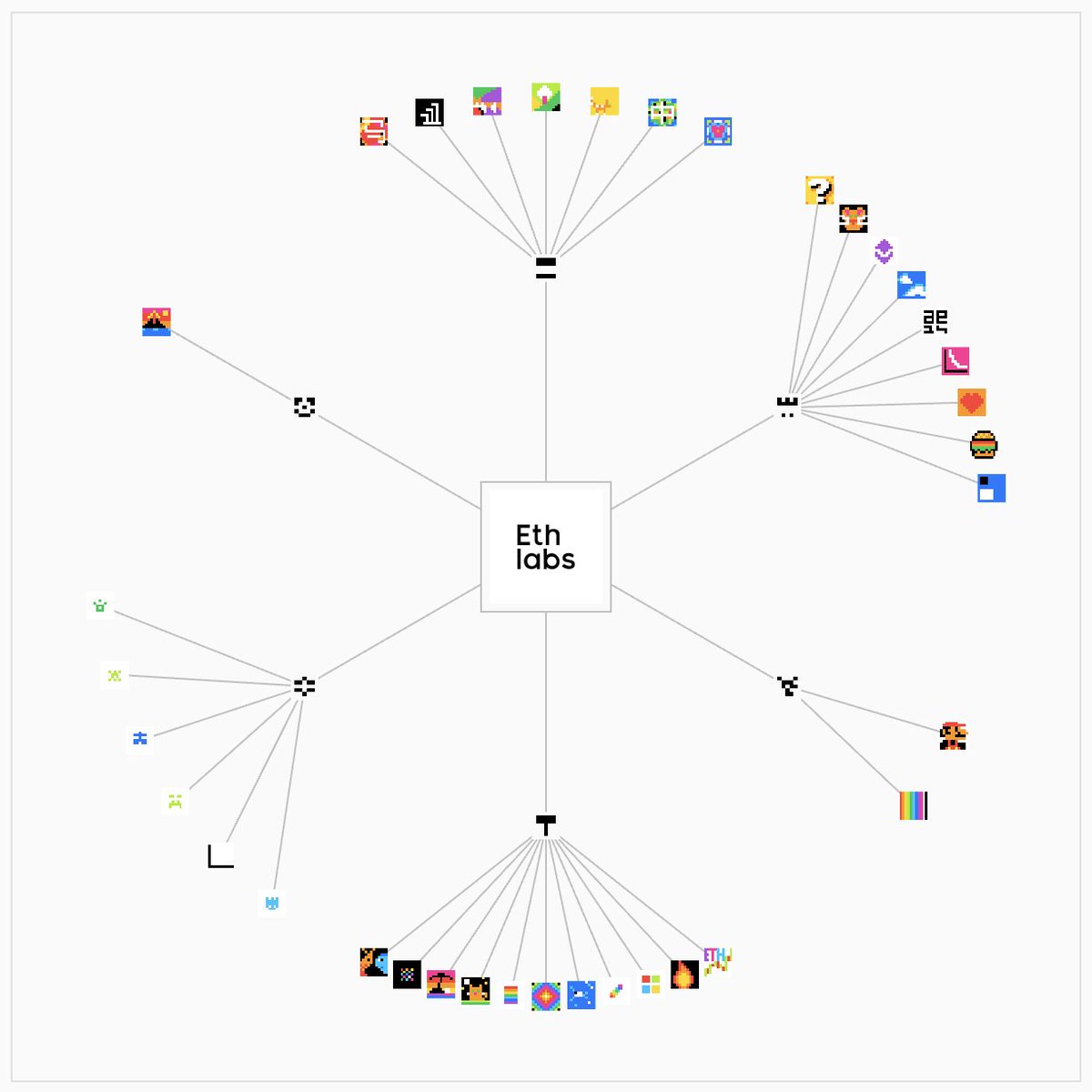
If you were online between Thursday and Friday this week, you might have seen some colourful pixel art gracing your timeline. To celebrate Ethereum’s 11th birthday, Ethlabs worked with @jalilwahdat, @jackbutcher and @yougogirl_eth to launch 11x11, an onchain project.
The rules were simple: An 11x11 grid, and 11 colours to choose from for each cell in the grid. Once your drawing is done, mint your NFT on Mainnet. Others can collect it too, while referrals connect your art to that of others, in an ever-expanding network.
Results: More than 35,000 pieces minted, and the #2 gas guzzler for the 24h period it was live.
Here is what our team has put to onchain paper:
We’ll have an upcoming article on lessons learnt from 11x11, so stay tuned for that. In the meantime, here’s what we were up to this week.
#Faster slots for Hegotá
The work continues towards proposing faster slots on L1 for the Hegotá Mainnet upgrade, which will follow Glamsterdam. Glamsterdam is set for release some time before end of year, and hopefully Hegotá can launch by late Q2/early Q3 2027.
Faster slots improve UX by confirming transactions quicker, reduce oracle and price staleness onchain, and even increase censorship-resistance by lining up more leaders per unit of time. Faster slots are also one of the protocol Strawmap’s objectives.
In terms of engineering, there is a one-time cost to pay in order to make slot time more of a parameter in protocol specifications and client code. Our proposal will argue for clearing this one-time cost in Hegotá, along with a moderate slot time decrease from 12s to 10s.
Doing this in Hegotá would allow for further slot time decreases in subsequent hard forks. It’s already a full slate for consensus layer changes starting from I*, the upgrade that will follow Hegotá, hence a reason to pay this one-time cost ASAP.
@fradamt and I got started on some specifications, available here. I’ve also been reviewing a study from last year, originally published by @misilva73 (Ethereum Foundation), to understand how propagation times have evolved over the last year.
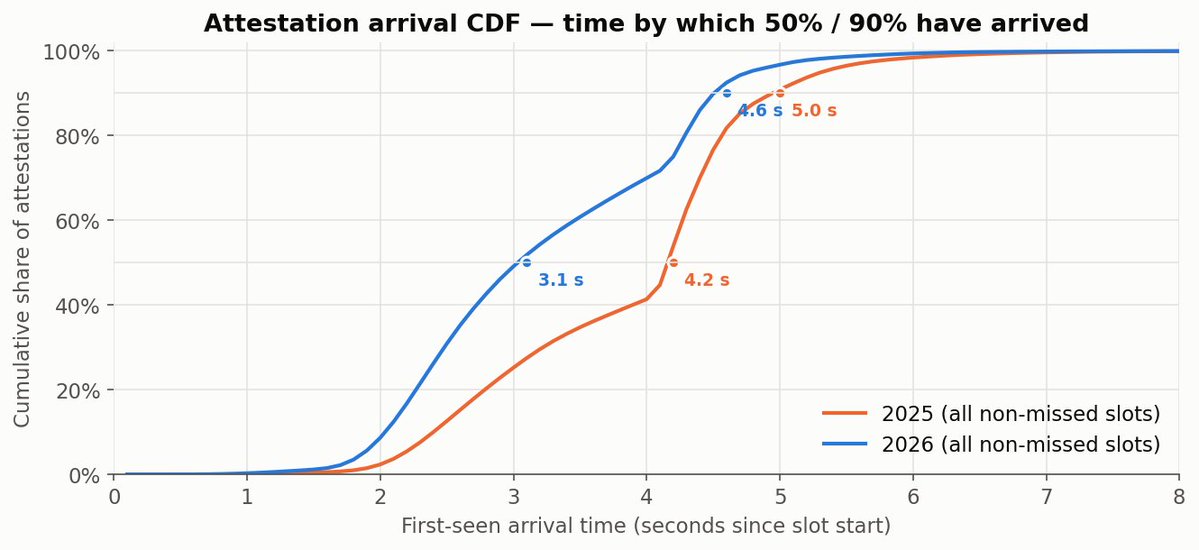
Good news: Things have improved! A smaller validator set in conjunction with outreach to slower validators appears to have reduced propagation latency across the board.
As a reminder, a smaller validator set also benefits faster finality, without hurting decentralisation as long as the same number of nodes remain on the network. Some great news from @LidoFinance on this front:
#Fast confirmation formal verification and go-to-market
Three quick updates on the Fast Confirmation Rule (FCR), an algorithm that provides a strong degree of confirmation in a much shorter amount of time than full economic finality. Fast confirmation is obtained in tens of seconds vs 15 minutes for full finality. This means much faster deposits from Ethereum to L2s and centralised exchanges, and faster settlement for bridges and other systems adopting FCR.
First, some bad news: Since ePBS, a Glamsterdam feature, decouples blocks of transactions from consensus blocks, FCR latency takes a hit, bringing it from (best case) ~13 seconds to ~24 seconds. While work is currently done to try and optimise this further, this is a further argument for faster slots in Hegotá!
Second, while tokenmaxxing ChatGPT 5.6 and Fable 5, @fradamt derived a formally verified proof of FCR properties. Formal verification has seen a drastic boost from AI, and yields machine-checkable proofs or code that are guaranteed to be secure. More on this coming soon.
Third, @_julianma is resuming go-to-market work for the Fast Confirmation Rule, having reached out to potential adopters. If FCR sounds interesting for your product, reach out for more details!
#Trade-Through Rule and L2 Classification
Regulatory clarity is a big potential driver of more participants in Ethereum’s markets. @_julianma is currently investigating one important proposal from the SEC to rescind certain rules that currently block natively tokenized equities from trading onchain.
The Trade-Through Rule requires that for certain tokenised US equities an exchange must prevent executing trades at prices inferior to protected quotations. For example, if a user would want to buy natively tokenised AAPL on a DEX, the DEX would have to ensure its quotes are not inferior to AAPL quotes on the NASDAQ.
Giving this guarantee is hard for DEXs as they cannot read NASDAQ quotes. The SEC’s proposal to rescind the Trade-Through Rule would remove one obstacle for natively tokenised equities trading on Ethereum.
We are engaging with policy experts as an input to our work streams, and thinking through how we can best engage or shape our own internal policy function. Shoutout to @c_spelliscy at Ethereum Foundation, @Etherealize_io, the Decentralization Research Center @TheDRC_, and others like @milesjennings at @a16z. Here is the SEC’s request for comment.
#On to Week 7.
I’ll be off for some of the next two weeks, after which we’ll all meet again for our first offsite 🔥 This will be the first get-together for the founding team, taking stock of our various efforts since our launch and charting a course for the year ahead.
See you next week!
Here’s last week’s update if you missed it.